


Shop Mulch
Learn






Waukesha County & SE Wisconsin
How Many Bags Are on a Pallet of Mulch? (Common Counts + Ranges)
Most mulch pallets hold 70 bags (2 cu ft) or 80 bags (1.5 cu ft), roughly 4.4 to 5.2 cubic yards. That covers a mid-size yard project, but what most people do not think about until the pallet is in their driveway is what it actually takes to work through 70 individual bags by hand. This guide covers the full breakdown below.
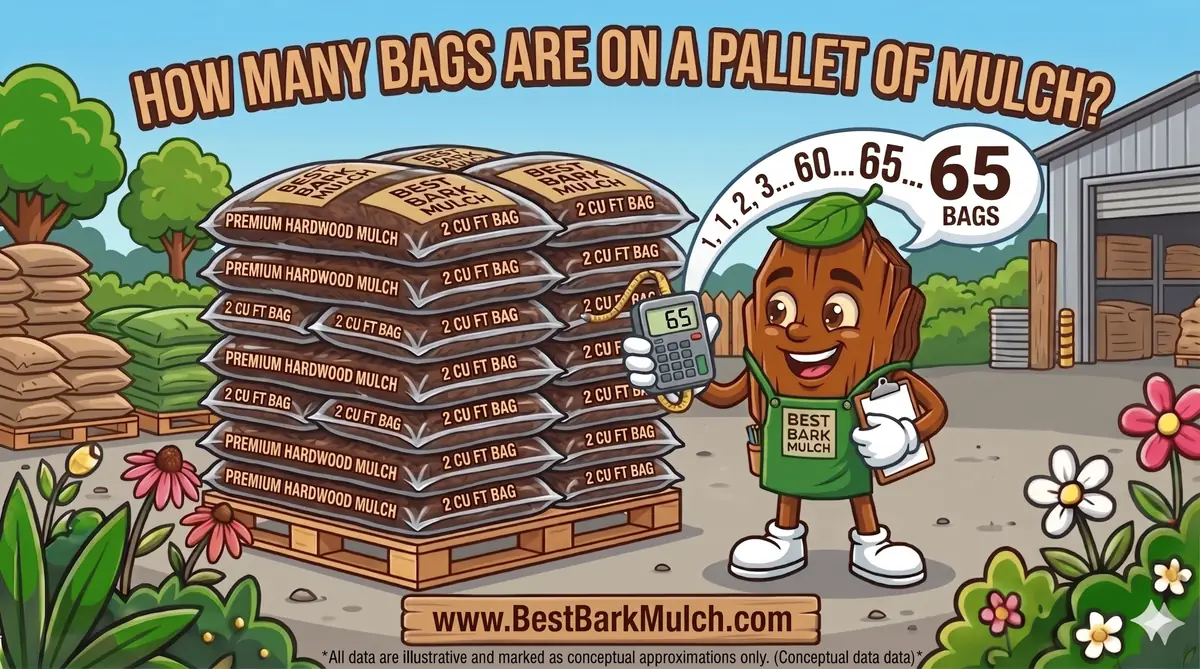
How Many Bags Are on a Pallet of Mulch? (Common Counts + Ranges)
Most pallets of mulch hold 70 bags. That is the standard at Home Depot for 2 cubic foot products like Vigoro and Timberline. If you are looking at 1.5 cubic foot bags (Earthgro), the count steps up to 80 bags per pallet. Those two numbers cover the vast majority of retail mulch pallets. Here is the full breakdown, plus what it means in cubic yards so you can decide whether a pallet covers your project.
The Quick Answer: Most Common Pallet Counts by Bag Size
The bag size printed on the label is the single biggest factor in how many bags fit on a pallet. Suppliers build pallets to a safe stacking height, not to a theoretical weight limit, which is why the numbers are more consistent than most people expect.
| Bag Size | Bags per Pallet | Total Cubic Feet | Approx. Cubic Yards | Coverage at 3" Depth |
|---|---|---|---|---|
| 1.5 cu ft | 80 bags | 120 cu ft | ~4.4 yards | ~480 sq ft |
| 2 cu ft | 70 bags | 140 cu ft | ~5.2 yards | ~560 sq ft |
| 3 cu ft | ~45 to 50 bags | ~135 to 150 cu ft | ~5.0 to 5.6 yards | ~540 to 600 sq ft |
Pallet counts for 2 cu ft products verified against Home Depot listings for Vigoro and Timberline (70 bags). 1.5 cu ft counts verified against Home Depot Earthgro pallet listings (80 bags). 3 cu ft configurations vary by retailer and region. Always confirm the count on the product page or with the supplier before ordering.
The 2 cu ft bag is the most widely available size in most markets and the most common pallet configuration at major home improvement retailers. If you buy a pallet of brown mulch at Home Depot, 70 bags at 2 cubic feet each is almost certainly what you are getting.
Why the Numbers Are Not Always the Same

Some sites calculate how many bags could theoretically fit based on a pallet's weight limit (up to 4,600 lbs). That math produces numbers well above 100, which sounds useful but does not reflect how suppliers actually build pallets. Real pallets are stacked to a safe handling height, not maximum weight. That is why 70 or 80 bags is the consistent real-world standard, not some theoretical ceiling.
Rubber mulch is the main exception. It is much heavier than wood mulch, so those pallets cap at a lower count due to weight before height becomes the issue. For specialty products outside the standard 1.5 or 2 cu ft sizes, verify the count on the product listing before ordering. For more on why mulch weight varies by material, see our Mulch Weight Guide.
What a Pallet Covers (And Whether It's Enough)

A standard 70-bag pallet of 2 cu ft mulch contains 140 cubic feet of material, which works out to roughly 5.2 cubic yards. At a 3-inch application depth (the most common for established beds), that covers approximately 560 square feet.
To put that in context: a typical front yard mulching project for a mid-size suburban home commonly runs 3 to 6 yards. A pallet sits comfortably in that range. For larger properties or full-yard refreshes, one pallet probably is not enough, and that is where the math starts to work against bagged mulch.
Not sure how much your project needs? Use our mulch calculator to get an exact cubic yard estimate before you commit to bags or bulk.
Pallet vs. Bulk Delivery: What the Numbers Actually Show

If you are pricing out a project and trying to decide between buying a retail pallet and ordering bulk delivery, the honest answer is: it depends on when you buy.
Using a standard 2 cu ft brown mulch bag and a bulk delivery price of $42 per cubic yard as the comparison point:
- At regular retail price (~$3.67/bag): 14 bags cover one cubic yard, costing about $51. Bulk delivery at $42 per yard is cheaper, and you do not have to go anywhere.
- At sale price (~$2.00/bag during spring events): 14 bags cover one cubic yard for $28. At that price, the bags win on cost, and there is no pretending otherwise.
Bag prices based on current Home Depot listings for Vigoro 2 cu ft brown mulch. Regular price approximately $3.67 per bag; sale price based on the annual Spring Black Friday event (5 for $10). Bulk pricing varies by supplier and region. Verify current prices before purchasing.
The sale window is real, and for small projects it is genuinely hard to beat. Home improvement retailers run those spring mulch deals at or below cost to drive store traffic during peak gardening season. No bulk supplier can compete with a loss-leader price on a short promotional window.
But price is only part of the decision. Consider what happens once the pallet is in your driveway: 70 bags means 70 individual tasks. Lift a bag (30 to 40 pounds of moist mulch), carry or wheelbarrow it to the bed, cut it open, dump it, rake it out, repeat. You are physically moving up to 2,800 pounds of material one bag at a time, then collecting and disposing of 70 large plastic bags that most municipal recycling programs do not accept.
Bulk mulch arrives as a pile. You move it to the beds with a shovel and wheelbarrow, which is the same motion regardless. No cutting, no plastic, no unloading before the real work begins. For projects at 3 yards or more, that labor difference is significant regardless of price.
When Buying a Pallet Actually Makes Sense
There are real scenarios where a pallet is the right call:
- It is spring sale season and your project is 3 to 4 yards. At $2 per bag, the math works. If you have a pickup truck and a free weekend morning, this is a legitimate win.
- You need a specific retail brand or color. Bulk mulch suppliers typically carry a limited color range. If your landscape requires a specific dyed product, bagged may be your only option.
- Bulk delivery minimums do not work for your project. Most bulk suppliers require a 3 to 4 yard minimum. For smaller jobs, bags give you flexibility on quantity.
For everything over 4 to 5 yards, and especially outside of the spring sale window, bulk delivery is almost always the better combination of cost, quality, and labor.
Frequently Asked Questions
How many bags of mulch are on a pallet at Home Depot?
Home Depot sells most mulch pallets in two configurations: 70 bags for 2 cu ft products (Vigoro, Timberline) and 80 bags for 1.5 cu ft products (Earthgro). The product listing always shows the exact bag count.
How many cubic yards is a pallet of mulch?
A standard 70-bag / 2 cu ft pallet equals approximately 5.2 cubic yards. An 80-bag / 1.5 cu ft pallet equals approximately 4.4 cubic yards.
How heavy is a pallet of mulch?
A typical 70-bag pallet of wood mulch weighs 2,100 to 2,800 pounds depending on moisture content. See how much a yard of mulch weighs for a full breakdown by material type.
Is buying a pallet of mulch cheaper than bulk delivery?
During spring sales (~$2 per bag), bagged mulch undercuts most bulk delivery prices per yard. At regular retail (~$3.67 per bag), bulk is typically cheaper. For projects over 3 to 4 yards, bulk also eliminates the labor of handling 70 individual bags.
Need More Than a Pallet?
If your project runs over 4 to 5 yards, bulk delivery is worth a look. You can check how many yards your beds need using our mulch calculator, then order bulk mulch delivery directly if bulk makes sense for your project. One order, one delivery, no bags to deal with.


Related Blog Posts
Transform Your Landscape with Premium Mulch – Sign Up for Exclusive Deals & Tips!
Revitalize Your Landscape Today!

mulchDelivery To following Cities
Wisconsin
and Waukesha County
mulch delivery in South Eastern
Wisconsin and Waukesha County
