


Shop Mulch
Mulch Info
Learn






Waukesha County & SE Wisconsin
Bagged Mulch at Home Depot, Lowe's & Walmart vs. Bulk Delivery: The Complete Cost Guide (Spring 2026 Prices)
Buying mulch at Home Depot, Lowe's, or Walmart this spring? Before you load up the cart, read this. We compared real spring 2026 bag prices against bulk delivery on an 8-yard project, with actual math, honest sale timing, and the quality issues no retailer will tell you about.

Every spring, millions of homeowners make the same trip. They drive to Home Depot, Lowe's, or Walmart, stack bag after bag of mulch into their cart, load up the car, drive home, unload everything, and start the process all over again when they run short halfway through the job.
Most of them overpay. Many of them don't finish in one trip. And almost none of them realize there's a simpler, often cheaper alternative sitting one Google search away.
This is the guide most mulch comparison articles don't give you — real spring 2026 prices from all three major retailers, a side-by-side cost breakdown on an actual 8-yard project, an honest look at what that $10 bag sale really gets you, and a clear answer to the question most homeowners are quietly asking: is bagged mulch from the store actually worth it?
What Does Mulch Cost at Home Depot, Lowe's, and Walmart? (Spring 2026)
Let's start with actual numbers. All three retailers sell mulch primarily in 2 cubic foot bags, with some variation by brand. Here's where pricing stands right now for brown and black hardwood mulch — the two most popular colors.
| Retailer | Brand | Bag Size | Regular Price | Current / Sale Price |
|---|---|---|---|---|
| Home Depot | Vigoro Premium Brown | 2 cu ft | ~$3.97/bag | ~$2.00/bag (Spring Black Friday, predicted April 2–15, 2026 — 1.5 cu ft Earthgro bags) |
| Lowe's | Sta-Green Premium Brown | 2 cu ft | ~$3.98/bag | $2.50/bag (current sale through mid-March); $2.00/bag (SpringFest, predicted April 2–30, 2026) |
| Walmart | Expert Gardener Brown | 2 cu ft | ~$3.67–$3.97/bag | Occasional rollback to ~$2.47/bag (timing varies) |
Prices verified from retailer websites, spring 2026. Prices vary by region and change frequently — always check your local store before purchasing.
A quick note on the sales: Home Depot's big annual deal — the one everyone knows as the "5 for $10" — uses their Earthgro bags, which are 1.5 cubic feet, not 2 cubic feet. That matters when you're doing the math. Lowe's SpringFest sale uses the full 2 cubic foot Premium bags at $2 each, which is why it often beats Home Depot's deal on a per-cubic-foot basis. We'll get into that in the comparison below. For the full seasonal sale calendar including Memorial Day and fall clearance, see our guide to when mulch goes on sale.
The Real Math: What 8 Yards of Mulch Actually Costs
Let's use 8 cubic yards as our project baseline — a realistic size for a full front and back yard refresh on a typical residential property. If you're not sure how many yards you need, use a mulch calculator first. Eight yards is also a useful number because it clearly illustrates the math that most articles skip.
8 cubic yards = 216 cubic feet. At 2 cubic feet per bag, that's 108 bags. Let that number sit for a second. We'll come back to it.
For how the bag-to-yard conversion works, see our full guide on how many bags are in a yard of mulch.
| Mulch Source | Regular Price (8 yards) | Sale Price (8 yards) | Trips to Store | Bags to Dispose Of |
|---|---|---|---|---|
| Home Depot (108 × $3.97) | $428 | ~$216 (spring, 1.5 cu ft bags) | Multiple | 108 |
| Lowe's (108 × $3.98) | $430 | $216 (SpringFest 5 for $10) | Multiple | 108 |
| Walmart (108 × $3.67) | $396 | ~$267 (rollback) | Multiple | 108 |
| Bulk — Brown/Black (8 yds × $42 + delivery) | ~$396–$456 | N/A — consistent year-round | Zero | Zero |
| Bulk — Standard Mixed (8 yds × $38 + delivery) | ~$364–$424 | N/A — consistent year-round | Zero | Zero |
Here's the honest read on this table: at regular retail prices, bulk is price-competitive with or cheaper than bagged mulch, before you factor in your time and fuel. At Lowe's SpringFest sale prices ($2/bag for 2 cu ft bags), bagged mulch does get significantly cheaper on sticker price — $216 for 8 yards is genuinely hard to beat.
But sticker price is only part of the story. Here's what the table above doesn't capture.
What the Price Tag Doesn't Tell You
Let's talk about what's actually inside those bags — because this is where the comparison gets uncomfortable for the big box retailers, and where bulk mulch earns its advantage in ways that have nothing to do with price.
Quality inconsistency is a real, documented problem
Bagged mulch sold at major retailers is typically manufactured at a regional level, sourced from a mix of wood debris, and shipped long distances before it ever reaches the shelf. The result is a product that can vary significantly — in color, texture, and what's actually in the bag — from one batch to the next.
These aren't hypothetical complaints. Here's what verified buyers of Walmart's Expert Gardener Brown Mulch have written in reviews:
"This mulch had logs, rocks, roots, clay items and other unidentifiable objects in it and is really trash."
"Beware of inconsistent coloring — picked up 20 bags, ran short then went back and picked up 15 bags. One group had a reddish tone, the other had a dark brown/black tone. Did not blend well at all."
One reviewer put it bluntly: "I wish they would deliver it though. I need so much of it, and can only fit so much in my SUV. Then I have to pull it out, and start the process again by going to purchase more. I can never get all that I need in one shot."
That last one is worth pausing on. This is a satisfied Walmart mulch customer — and even they are describing exactly the problem that bulk delivery solves.
What's actually in cheap bagged mulch?
Cheap bagged mulch from big box retailers is frequently made from a blend of wood debris that can include crushed pallets, construction wood, and other recovered material — not just fresh-cut timber. This affects color consistency, breakdown rate, and how the mulch looks in your beds six months after you put it down. Lawn care professionals on industry forums are blunt about it: "Most bagged mulch (Home Depot) looks nasty and it's not as natural looking" is a common sentiment.
Bulk mulch from a reputable local supplier is a fresher product. It hasn't been sitting compressed in a plastic bag under warehouse fluorescents. It hasn't been shipped across the country. And a good local supplier is sourcing from consistent material — not whatever the regional manufacturer had available that week.
Bags can trap moisture and mold
Mulch in plastic bags is a closed environment. If the mulch was even slightly damp when it was bagged — which is common — that moisture has nowhere to go. Bags sitting outside at the garden center through a rainy spring are a particularly common source of moldy or sour-smelling mulch that can temporarily harm plants if spread immediately. Bulk mulch, by contrast, is an open pile that breathes naturally.
The Hidden Cost of Bagged Mulch: Time, Trips, and the 108-Bag Problem
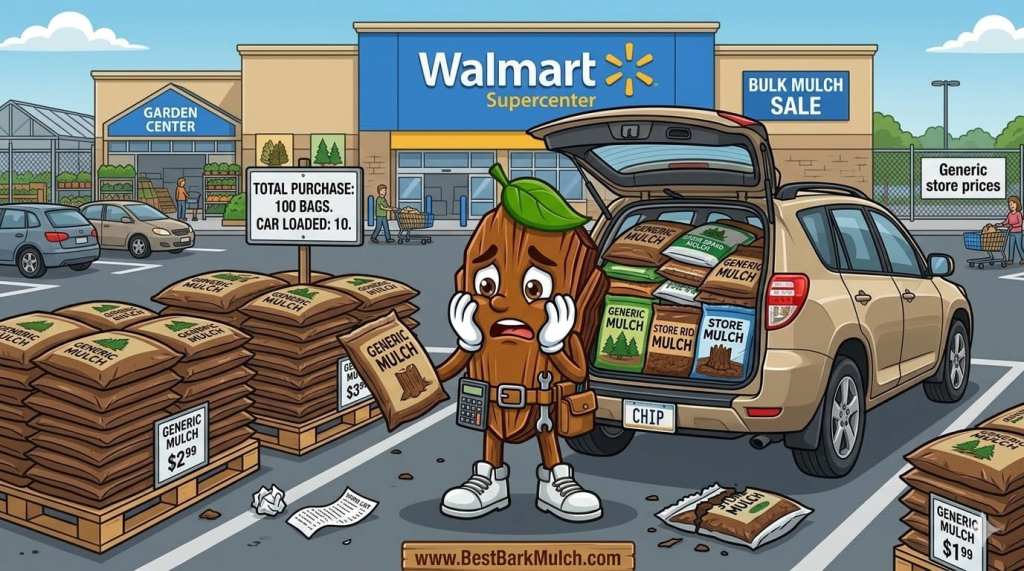
Back to that number: 108 bags for an 8-yard project.
How many bags fit in a typical SUV or car? Practically speaking, you're loading 20–35 bags per trip without straining your vehicle or your trunk liner. That's 3 to 5 trips to the store for an 8-yard project — each one involving parking, cart loading, checkout, loading the car, driving home, unloading, and stacking. You're easily looking at 4 to 6 hours of your Saturday before you've touched a single shovel.
If you have a full-size pickup truck you can do better — a pickup truck holds roughly 2 to 2.5 yards of mulch, so 8 yards is still 3 to 4 trips. And you're still dealing with the residue in your truck bed, the tarp situation, and hauling it all yourself.
Then there are the bags themselves. 108 empty mulch bags are a logistical headache — they're big, they're awkward, and most municipal recycling programs don't take them. You're stuffing them in your trash or making a separate trip to dispose of them.
Bulk delivery eliminates all of this. A truck shows up, dumps a pile in your driveway, and leaves. Your entire job is moving it from the pile to your beds — which you were going to do anyway.
When Bagged Mulch Actually Makes Sense
This guide would be doing you a disservice if it pretended bags are never the right choice. They are — in specific situations.
- You only need 1–2 yards total. The minimum order for most bulk delivery services is 3–4 yards. For a small touch-up job or a single flower bed, bags give you the exact quantity you need.
- You don't have a good drop spot. Bulk delivery requires a safe, accessible area for the truck to dump — typically a driveway or parking pad. If that's not available at your property, bags may be your only practical option.
- You want to spread the work over multiple weekends. Bags let you work at your own pace without a pile sitting in your driveway. For some homeowners, that flexibility is worth the extra cost and trips.
- It's the spring sale, you have a truck, and you need under 4 yards. At Lowe's SpringFest prices ($2/bag), small quantities from a pickup truck make real financial sense. This is the scenario where bags genuinely win.
Not sure how many bags your project actually needs? Use our Mulch Calculator — plug in your bed dimensions and depth and it'll tell you exactly how many bags or yards you need before you buy a single thing.
When Bulk Mulch Is the Clear Choice
For most homeowners doing a real mulch project — refreshing multiple beds, covering a front yard, or tackling a full property cleanup — bulk delivery is the practical and usually more cost-effective option. Here's a quick decision table:
| Project Size | Recommendation | Reasoning |
|---|---|---|
| 1–2 yards | Bags (probably) | Below most delivery minimums. Bags work fine at this volume, especially during a sale. |
| 3 yards | Either | Borderline. If you're near a sale, bags can compete on price. If you value your time, bulk wins. |
| 4–6 yards | Bulk | Multiple store trips required for bags. Bulk is competitive on price and dramatically easier. |
| 7+ yards | Bulk | No question. Self-hauling this quantity in bags is a half-day project before spreading begins. |
And if you want to skip the spreading part entirely, some bulk suppliers offer a full installation service where the mulch is delivered and spread for you. It costs more, but for busy homeowners it's worth every dollar — you place one order and your beds are done.
For a deeper dive on the delivery logistics and what to expect on delivery day, our Bulk Mulch Delivery Guide covers the full process.
How to Order Bulk Mulch (And What It Costs in SE Wisconsin)
If you're in southeastern Wisconsin, Best Bark Mulch delivers bulk mulch across Waukesha County and the surrounding SE Wisconsin area. Here's what pricing looks like:
- Standard Double Grinded Mixed Mulch: $38/cubic yard
- Chocolate Brown, Black, or Royal Red: $42/cubic yard
- Premium Cedar or Hemlock: $52–$55/cubic yard
- Delivery fee: Zip-code based — enter your zip at checkout for an exact quote
- Minimum order: 4 yards
- Installation add-on: $60/yard — mulch delivered and spread for you
All mulch is 100% recycled hardwood, sourced locally — not pallet wood or construction debris. You can browse mulch types and schedule a delivery here, or add professional spreading if you'd rather skip that part of the job.
Not in our service area? The same principles apply wherever you are — search for a local bulk mulch supplier or landscape supply company near you and run the same math. At most order sizes above 3 yards, local bulk beats retail bags on price, quality, and convenience.
Frequently Asked Questions
Is Home Depot mulch good quality?
It's serviceable for decorative purposes but inconsistent. Home Depot's main brand, Vigoro, is manufactured regionally and can vary in color, texture, and material composition. Common complaints include debris in the bag, fading faster than expected, and color variation between bags purchased at different times. For small touch-up jobs it works fine. For a large project where consistency matters, local bulk mulch from a dedicated supplier is a more reliable option.
Is the Lowe's 5-for-$10 mulch deal worth it?
On sticker price alone? Yes — the 5 for $10 mulch deal is the best retail price available. At $2/bag for 2 cubic foot bags, you're paying $1 per cubic foot, which is genuinely competitive with bulk delivery when you factor in a delivery fee. The tradeoff is the time and trips required to haul that many bags yourself. For smaller projects under 3 yards, or if you have a truck and enjoy the project, it's a solid deal. For larger projects where you'd need 50+ bags, the convenience advantage of bulk delivery usually tips the scale even at that sale price.
How much does bulk mulch cost compared to bags?
At regular retail prices, bulk mulch is typically cheaper per cubic yard than bagged mulch, even with a delivery fee factored in. On an 8-yard project, regular-priced bags from Home Depot or Lowe's run approximately $425–$430, while bulk delivery (mulch + delivery fee) typically runs $360–$460 depending on your location and the mulch type. During major spring sales, bagged mulch can temporarily undercut bulk on sticker price — but that doesn't account for your time, multiple store trips, or disposal of 100+ bags.
What's the cheapest way to buy mulch?
For smaller projects (under 3 yards), catching Lowe's SpringFest or Home Depot's Spring Black Friday sale and hauling it yourself is hard to beat on pure cost. For larger projects (4+ yards), local bulk mulch delivery is almost always cheaper on a per-yard basis at regular pricing, and the math gets even better when you account for your time. The "cheapest" option also depends on whether you value your Saturday afternoon — because hauling 100 bags yourself is a real cost, it just doesn't show up on a receipt.
Is bagged mulch better than bulk mulch?
Not typically. Bulk mulch from a reputable local supplier is generally fresher (no time in a sealed plastic bag), more consistent in color and texture, and sourced from cleaner material. Bagged mulch has the advantage of precise quantities and no delivery minimum — those are real benefits for small jobs. But for quality and value on medium to large projects, bulk wins most of the time.


Related Blog Posts
Mulch Weight Guide: How Much a Yard, Bag, and Pallet of Mulch Weigh
When Does Mulch Go On Sale? (Seasonal Patterns + What to Watch For)
Is the 5-for-$10 Mulch Sale Actually Worth It? (Home Depot vs Lowe's Cost Breakdown)
Mulch Delivery vs. Pickup: The True Cost (Time, Trips, and the Mess No One Talks About)
Bulk Mulch Delivery Explained: Pricing, Scheduling, and What to Expect on Delivery Day
How Many Bags Are in a Yard of Mulch? Conversion Table by Bag Size
How Much Does a Yard of Mulch Cover? (Coverage by 1", 2", 3", 4")
Mulch Calculator Guide: How Much Mulch Do I Need? (Depth, Coverage, Ordering)
How Many Cubic Feet Are in a Yard of Mulch? 1 cubic yard of mulch equals 27 cubic feet (27 ft³)
Unlock the Secrets: Benefits of Mulch You Need to Know
Transform Your Landscape with Premium Mulch – Sign Up for Exclusive Deals & Tips!
Revitalize Your Landscape Today!

mulchDelivery To following Cities
Wisconsin
and Waukesha County
mulch delivery in South Eastern
Wisconsin and Waukesha County
